 Share Predictions


First Trust Senior Floating Rate Income Fund II (FCT) stock analysis and AI prediction
The company facts of First Trust Senior Floating Rate Income Fund II, with its price and AI prediction for the next 10 market days in SharePreds.

Keep looking in SharePreds
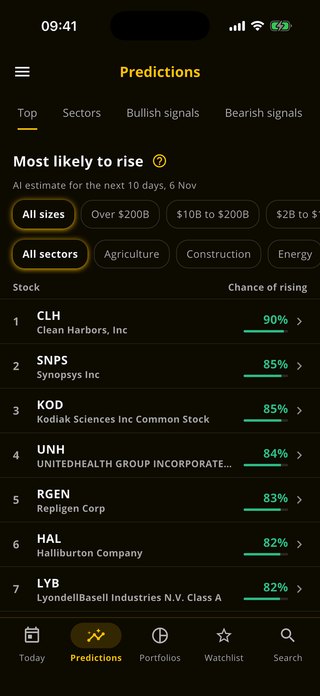
You have looked at today's stocks on this website. SharePreds shows every stock's likelihood of rising, its chart and how its earlier predictions ended, with alerts on the ones you follow.
 Scan with your phone


About First Trust Senior Floating Rate Income Fund II
First Trust Senior Floating Rate Income Fund II is a United States-based diversified, closed-end management investment company. Its investment objective is to seek a high level of current income. As a secondary objective, it attempts to preserve capital. The fund invests in a portfolio of senior secured floating-rate corporate loans (Senior Loans) of companies from different industries, such as Insurance, Software, Health Care Providers and Services, Professional Services, Health Care Technology, IT Services, and others.
- Exchange
- NYSE
- Market value
- $250.7 million
- Size
- Micro cap
- Listed since
- May 26, 2004
- Website
- ftportfolios.com
FCT questions
What is the AI prediction for FCT stock?
Each market day our model rates First Trust Senior Floating Rate Income Fund II (FCT) Bullish, Neutral or Bearish for the next 10 market days. Predictions are indicative: they rest on price and volume data, and they can be wrong.
How often is the FCT prediction updated?
Each market day, Monday to Friday, except market holidays. The date of the prediction is shown beside it.
What do Bullish, Neutral and Bearish mean?
Bullish means the model sees a rise as likely over the next 10 market days, Bearish a fall, and Neutral no clear direction.
Where can I see the exact likelihood for FCT?
In the SharePreds app for iPhone and Android, with the stock's chart, alerts on it and how its earlier predictions ended.
Where can I see FCT options?
The FCT options page opens its calls and puts, with price, volume, implied volatility and the Greeks.